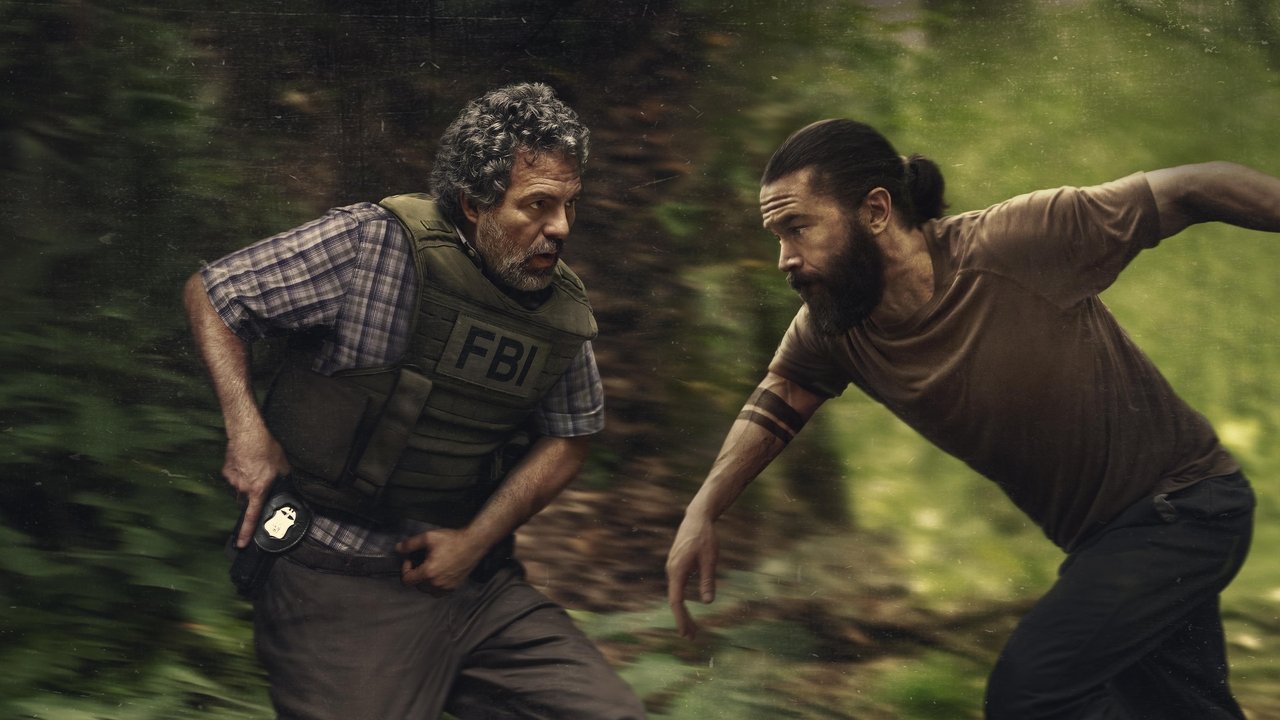
Halfway through Task you may notice something that has nothing to do with what happens on screen. The events keep arriving, seven episodes' worth, and not one of them feels like luck. Nobody overhears the crucial phone call. Nobody happens to drive past the right house. The plot moves at speed and still never asks you to look away while it cheats. That is rare enough to be worth taking apart, and taking it apart happens to explain the show's one real failure as well.
The premise is ordinary on paper. A federal task force in the working-class suburbs outside Philadelphia goes after a run of violent robberies on biker turf. Mark Ruffalo plays the agent running it, a former priest who has stopped believing in most of what he used to. Tom Pelphrey plays the man behind the robberies, a widowed garbage collector holding what is left of a family together with both hands. Two men, opposite sides, one collision.
Two ways to build a scene
There are broadly two directions you can write from, and they leave different fingerprints.
The first is from the outside in. You decide the shape of the story first — a reveal here, a reversal there, a body at the end of episode six — and then you find people who can be made to produce those beats. This is how most crime television is built, and it is not shameful; the whodunit in particular almost requires it, because a mystery runs on withheld information, and someone in the frame has to be concealing something for the machinery to work.
The second is from the inside out. You establish who someone is and what they cannot stop wanting, and then you apply pressure and follow. You do not decide in advance what happens in episode six. You decide where the character has to end up emotionally, and let the road build itself.
The test is simple: could this scene have gone differently, and would we still believe it?
Task is built the second way, and it shows in the smallest joints. When the garbage collector makes his next move, it does not land as a plot development. It lands as the only thing a man that frightened, that indebted and that responsible for other people could possibly do next. It surprises in the moment and looks inevitable ten minutes later — which is the whole trick, and it cannot be faked by outlining harder.
The architecture supports it. This is not a mystery: you know who did it from early on. It is a collision course, in the tradition of Michael Mann's Heat, where the tension comes from watching two men act rationally within their own worlds and understanding that those worlds cannot both survive contact. Structurally that is a far more honest generator of causality than a mystery, because neither side needs to behave stupidly for the story to keep going. The writer does not have to put a thumb on the scale. He only has to keep both men consistent, and the collision does the rest.
Where the seam shows
Which brings us to the part of the show that does not work, and to why it is instructive rather than merely disappointing.
One member of the task force is a dirty cop. He has been feeding the bikers for two years. Over the season he starts a relationship with a young woman on the fringes of the case, and the relationship is meant to humanize him before he is exposed. Every element of that sentence is a function. The show needs an informant inside the unit, so there is one. It needs the informant to be sympathetic before the reveal, so he gets a romance. It needs him pushed toward the endgame, so the romance ends in the worst possible way.
Watch it next to the main line and the difference is almost embarrassing. The two leads were given poles — faith and its loss, fatherhood, debt, guilt — early, clearly, and everything downstream is a consequence. The dirty cop was given props instead of poles: a fragment of Catholic upbringing, a hesitation about a bed that belonged to another marriage, tears at a graveside. Each of those beats is legible on its own. None of them is caused by the previous one. He is a man assembled from moments rather than grown from a premise, and no amount of good playing can hide that, because the problem is upstream of performance.
The young woman fares worse. She is written as unguarded, awkward, unready — a real and specific kind of person — but the writing keeps reaching for that quality as a note to play rather than a condition to develop, so what should read as an adult with a low opinion of herself reads instead as someone much younger than she is. And then she dies, and the death is not the end of her story. It is fuel for his. The show grieves her through him. That is the exact moment the second method takes over from the first, and once you have seen it you cannot unsee it.
The missing eighth hour
The likeliest culprit is arithmetic. Seven episodes is a beautiful length for two protagonists and a straight line between them. It is not enough for two protagonists, a straight line, a corrupt third party, a romance and a bereavement. Something had to be compressed, and the thing that got compressed was the thread that was already the most fragile, because it was the one built from function rather than character. Under compression, a character-first line loses detail. A function-first line loses coherence.
Either fix would have worked. Give it an eighth and ninth hour and the informant becomes a person. Cut it entirely, leave the bikers as weather rather than as a subplot, and the collision gets even cleaner. What we got is the version that half-commits, and the seam is visible from the outside.
Watch it anyway
None of this is an argument against the show. It is very well made, sometimes startlingly so, and Ruffalo and Pelphrey are doing the kind of work that does not announce itself. There is even an oddity in the music — a bright pop cue dropped into a bleak hour — that plays like a small tonal misjudgement in an otherwise disciplined register, which only stands out because so little else does.
It earns its place here for a specific reason. Most well-made television teaches you nothing about how television is made; it is too seamless to be legible. Task runs both methods at once, in the same seven hours, with the same cast and the same budget, and lets you compare them directly. It is a working diagram of the difference between a story that comes out of people and a story that people are hired into.
You can feel that difference without any of this vocabulary. Most viewers do — it arrives as a vague sense that one thread is thinner than the rest, that a romance came out of nowhere, that a grief belongs to the wrong person. That feeling is not fussiness. It is accurate structural perception, working before it has words. The words only confirm what the watching already knew.